
Episode 4 - Decentralizing the Grid for National Security
Updated: Mar 3
We’re talking about war.
Wanna listen? Vlog
Decentralization addresses local needs efficiently
Decentralization has allowed for large systems like democratic governments to function efficiently by empowering communities to deal with issues locally. During elections decentralization allows for communities to ensure fair elections can happen during difficult circumstances. During Hurricane Helene in North Carolina, voters were still able to cast their ballot if they temporarily relocated or even lost their photo IDs during the storm, thanks to decentralization.
Similarly the infrastructure and systems providing basic needs should be able to adjust operations and procedures based on the local conditions of their communities. People deserve the same resiliency and flexibility from the grid when natural or manmade disasters - even those of “biblical” proportions - strike.


Decentralization of the grid means using small local power plants to directly serve towns and neighborhoods instead of relying on a few large power plants to serve millions of people across multiple states. We have traditionally relied on large centralized marketplaces to meet the power needs of people. The largest electricity marketplace in the country currently serves over 67 million people.
Even the District of Columbia, the United States Capitol, relies on PJM to meet 98% of its electricity demand, where power is imported from large centralized power plants found in surrounding states.
We've been building on the idea that the grid is very local - how data, visibility, conditions, and even market prices can change every few blocks. In the last episode we really emphasized how increasing the amount of local on-grid or decentralized power can directly strengthen the grid and lower local electricity prices. And even though electricity prices have become a subject of local and national elections, the importance of decentralizing the power grid doesn’t end at addressing electricity prices.
The electrical grid is a target during war
Decentralization of the power grid addresses a major national security issue. In this day and age of waging war the power grid is a direct target. During war and conflict, the common people are targeted as a strategy of war to coerce a side into some type of agreement.

Civilians aren’t just directly targeted, the systems we rely on for basic needs are also directly targeted. Critical infrastructure enabling the delivery of basic needs for the people are subject to direct, intentional, repeated attack.
The electrical grid is the backbone of modern societies ensuring not just electricity but also the reliable delivery of water, access to sanitation, heating, food production, healthcare, and emergency services.
During times of crisis a centralized power grid is a major vulnerability because it presents single points of failure. Knocking out a single power plant can remove access to power for thousands if not millions and consequently access to water, warmth, food, and healthcare.
The United States is preparing for aerial attacks at home
War and direct attacks on the US may feel unlikely to ever materialize because of long brewing cold wars and separation thanks to the Oceans. But the Department of War’s 2026 National Defense Strategy says otherwise with a direct focus to develop the President’s Golden Dome to protect the US from aerial attacks.

The Department of War’s 2026 National Defense Strategy isn’t a plan that is just “words” mentioning a few regions, issues, and goals, the US has been following through with action on addressing narco-terrorism and engaging Greenland, China, and Iran. And Iran now quite directly.
We’ve seen the increased movement of the American Military around the world in areas listed in the 2026 National Defense Strategy document as proof.
Why should we not take the potential of aerial attacks seriously - when even the Department of War (DOW) has listed that as a concern?

Ask yourself this, if it’s globally known that the United State’s power grid is limited, weak, and aged to the point where it has become a large enough issue to impact local and state elections, then wouldn’t this system be a direct target of aerial attacks during war?
What would happen if a major power plant serving millions of people was taken out in the middle of winter? How quickly would a state or city be able to recover and secure warmth, water, and food for its people?
Even our nation’s capitol’s ability to reenergize itself is limited. Although its largest electricity-generating facilities are located at government sites, they address only 2% of the power consumed as a city.


Ukraine: Aerial attacks to the grid is a real war strategy
We know, as a fact, that the power grid is targeted by aerial attacks during conflict and that decentralized power is a direct solution. Ukraine stands as proof.
Ukraine has experienced direct and repeated attacks to its power infrastructure throughout its four years of war, forcing them to accelerate their efforts to decentralize and strengthen their energy systems. Two thirds of their pre-war power generating capacity has been destroyed with power plants and transmission lines being direct targets.

The attacks have had an annual pattern - aerial attacks on the power grid during autumn at the onset of bitter winters, when energy needs will be the greatest, when there’s a real physical need to stay warm. Ukraine’s energy infrastructure has been deliberately targeted to undermine its war efforts.
As a countermeasure Ukraine has been deploying small modular gas turbines and rooftop solar with batteries adding enough capacity to power 400,000 households.

US DOW and DOE don’t seem to be aligned on defense
The Department of War’s Strategy to develop the Golden Dome to protect the US from aerial attacks - drones and missiles is reasonable. But the Department of Energy (DOE) which is responsible for investing in protection against cyber and physical attacks on U.S. energy infrastructure has not mentioned protecting power plants and transmission lines against aerial attacks or decentralizing the power grid to increase energy security.

The DOE has been more recently focused on modernizing existing centralized coal power plants to meet immediate power needs and accommodate the large scale power demands of data centers. They have started their dispersal of funding for modernizing coal-power plants and have launched the Genesis Mission to accelerate science and innovation through AI.


US House Armed Services Committee concerned over aerial attacks to critical infrastructure
The House Armed Services Committee has shown concern over aerial attacks on critical infrastructure in its proposed National Defense Authorization Act for Fiscal Year 2026 which has passed the Senate.

However, directly addressing the protection against unmanned aircraft relating to DOE is limited to the protection of only nuclear facilities which outlines how and when the Secretary of Energy shall engage with unmanned aircraft vehicles.

Since the definition of critical infrastructure, used in the proposed National Defense Authorization Act FY 2026, is broad and includes national public health and safety, our energy systems should be considered as critical infrastructure requiring protection against aerial attacks.

Gold is penetrable
I trust that the Golden Dome will be able to deter and defend against aerial attacks. But gold is penetrable. Israel has an Iron Dome in place that has been able to deter and defend against most aerial attacks. But in 2025, Iranian missiles were still able to penetrate their air defenses.
Keep in mind the area of Israel is much smaller than the whole of the United States. These systems are essentially mobile missile defense systems that can intercept incoming attacks.

If the US power grid that consists of millions of miles of transmission lines and every major power plant is targeted as fair game during war, it will be difficult to defend against each and every aerial attack. It becomes even trickier from a central government point of view to pinpoint which lines and power plants justify being defended versus not.
Decentralizing the grid to defend against aerial attacks
At the beginning of the war Ukraine’s energy security was their Achilles heel. Four years into the war through their investment in distributed energy resources and aerial defense measures, their energy sector is now a vital line of defense.
Their strategy has been to deploy hundreds of generation facilities up to 10 MW each.
For comparison the largest power plant in PJM, which serves 1.4 million homes, generates 1875 MW of power. So each new modular power plant in Ukraine should serve at most 7500 homes.

Ultimately decentralization is logical. It’s harder to take out smaller and widely dispersed energy assets versus having to swarm one large power plant. It reduces single points of failures.
Large centralized power plant locations are also publicly known and visually easily identifiable. It's not just the power plant that is a target. The transmission lines around a major power plant that deliver power to homes can be just as easily targeted - if not easier to target.

Advanced aerial attacks

Most advanced aerial attacks heavily depend on machine learning and reinforcement learning to determine best flight paths to a target, identifying a target in the field, evading counter attacks, and determining when a mission is "complete". Advanced drone attacks are decentralized, relying on distributed control to autonomously learn about their environment, withstand attacks, and learn how to best overwhelm a target by communicating and collaborating amongst each other.
Decentralized drone swarms are able to attack multiple targets and determine when a mission has been completed without needing any human intervention. Drone swarms still function best when they are able to swarm, saturate, and overwhelm a single target through learning and coordinating multiple waves of attacks.
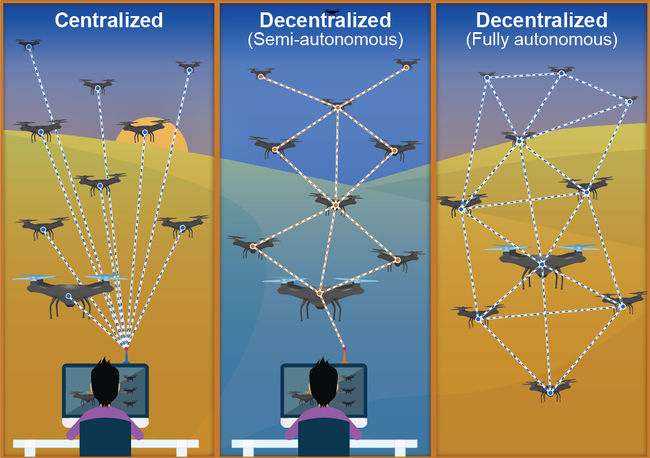
Decentralized power provides a vital buffer. In order to impact energy security for 1.4 million households, aerial attacks have to target almost 200 distributed power plants and their respective distribution lines, whose specific connections are not always publicly known as it can be considered confidential data and also underground.

However, in defending against drone attacks, decentralized power can be just as visually identifiable as large power plants.
If a drone has been sent out to search an area for decentralized power like rooftop solar, it will be able to identify it easily with high resolution imagery. Rooftop solar can already be identified through satellite imagery which is of much lower quality.
Stationary decentralized power is still limited in the face of advanced aerial attacks.
We know the best defense tech is mobile - it moves, evades, repositions. Why not enable mobile decentralized power?
Mobility strengthens the Iron Dome
One of the Iron Dome's strengths is its mobility. It's a mobile system that can relocate and reposition based on evolving conditions. It's a lot harder to target a moving object.

The Iron Dome is believed to consist of 10 mobile batteries, each made up of three essential parts: radars; three or four launchers, each holding 20 interceptor missiles; and a manned control centre from where defense personnel oversee interceptions.

Mobile Decentralized Power
Power generation assets have traditionally been stationary. If something is tied to a roof, a home, or the ground, it is a sitting target. It can be protected only through counter attacks or passive defense mechanisms. A moving target is a lot harder to hit. But power can literally moves on wheels now.
Traditionally electric mobility like Electric Vehicles have only been able to consume electricity to charge their batteries, but now with the advent of bidirectional charging (V2G), an Electric Vehicle is able to actually provide electricity to something like a home.

Large pickup trucks enabled for V2G like the Chevy Silverado EV RST carry enough energy to provide power to essential loads for 20 homes for up to 24 hours. There are also motorcycles enabled for V2G which can power 1 to 2 homes. Electric vehicles of all types hold batteries that are typically much larger than residential stationary batteries, enabling them to power multiple homes.
Pickup trucks enabled for V2G
Vehicles like Ford's F150 Lightning, Tesla's CyberTruck, and GM's Chevy Silverado RST are enabled for bidirectional charging. The size of the batteries can be 10 to 20 times the size of residential batteries. So a single EV truck could be used to power 10 to 20 homes during a natural or manmade outage.

Motorcycles enabled for V2G
Damon Motorcycles uses a lithium-ion battery holding 20 kWh of energy, enough to power the essential loads for1 to 2 homes for 24 hours. Damon Motorcycles is also capable of bidirectional charging.

There are also technologies that can generate and hold more energy like Dragon Wings and Sunbelt Batteries that aren't Electric Vehicles but are still mobile and resilient. These technologies can reliably power small communities (60 to 70 homes) individually and can be daisy chained to power larger communities as well. These technologies require a truck or trailer to be transported.
Dragon Wings - Solar Generator
Dragon Wings have the same form factor as a standard shipping container and can be stationary or moved using a truck or trailer. Dragon Wings expand into a large solar panel array capable of generating 70–150 kW daily. Dragon Wings also have onboard energy storage capacity of 75kWh, which can power ten homes needing only essential loads for 24 hours. Dragon Wings can act as a standalone solar generator and can be combined with external energy storage, generators, and the grid.
Dragon Wings have been tested to power small communities during Burning Man Festival and was even used during the 2024 Super Bowl in Las Vegas.

Sunbelt Batteries
Sunbelt has been in the industry for some time. They focus on industrial solutions and providing on-site temporary power. Previously they produced more portable gas generators but have moved to scaling their battery product offering.
Their highly portable 75 kW/600 kWh battery system can power 50 to 60 homes.

The obvious strength about these mobile power technologies in regards to aerial attacks is that they can move. They can be moved away during targeted attacks and moved in to restore power. They can even be used to travel to an area with more sunlight, a fuel source, or a viable connection to the grid.
However their other main strength, is that they are not visually identifiable sources of power. These mobile technologies are able to blend in with normal cars, motorcycles, and shipping containers. An advanced unmanned aerial vehicle will not be able to easily identify which unmarked shipping container may actually be Dragon Wings nor will it be able to easily differentiate between a normal Ford F150 and F150 Lightning.
Decentralized Community Action
As civilians not all of us are ready to commit to a specific technology. If we can invest in making the connection to decentralized power possible, we will have some source of local resilience in our communities regardless of the type of disaster.
From a local perspective to enable decentralized power:
A civilian needs to invest in technology that allows their home to disconnect from the main grid and connect to some other source of power.
The electric panel needs an automatic transfer switch to switch to a different source of power - rooftop solar, home batteries, V2G vehicles.
Utilities need to increase visibility into secondary mappings, so we know where a point of failure has occurred for any reason.
Communities need to introduce redundancy, extra lines, into their local grid to mitigate single points of failure within the distribution grid.
Enable neighboring homes to connect to each other and support one another during any type of outage - natural or manmade.
The energy sector should not be our Achilles heel during the aerial attacks that the US is actively preparing for. We should not solely rely on the Golden Dome to protect our local communities. We should literally be able to move and flex Power.
It is not clear what government organization at what level would take this on. It's likely that in line with the theme of decentralization, local state and even city governments will lead their communities to decentralize and mobilize their local grid. The DOE has been focused on large centralized power, which aligns with our nation's use of decentralization to address federal and local issues separately.
We have local government agencies responsible for local energy and defense within each state and even city. That is why, although we have the United States military, we still have state National Guards to handle local defense issues. It's possible that National Guards and emergency services will be the ones to expand their fleets to include mobile decentralized power technologies. As crises both natural and manmade increase, decentralization will enable not only stronger energy security but also stronger decision-making and therefore national security.
Last modified 02/26/2026 with updated description of Dragon Wings Specifications from Joe Coyne - Director of Product
References:
The impacts of war on health, human rights, and the environment—an overview
ICRC: When the lights go out: the protection of energy infrastructure in armed conflict
DOW Defense Strategy 2026 - addressing "narcoterrorism" with capture of Maduro
Atlantic Council: Five potential attacks scenarios from Russia
Germany decides to leave history in the past and prepare for war
Taiwan US Firepower center to hone asymmetric warfare tactics
Poland Energy Analysis - centralized Gas Power Plants are a weakness in face of Russian attacks
Ukraine’s Energy Sector: Resilience After Three Years of Full-Scale War
Virginia lawmakers seek to balance energy affordability, reliability in 2026
Electricity rates a potent political issue ahead of 2026 midterms
FACT SHEET: The Department of Energy Is Ending The War On Beautiful, Clean Coal
Investing in Energy Security: How Ukraine is transforming its energy system in wartime
DOE Genesis Mission National Science and Technology Challenges
Reinvigorating America’s Beautiful Clean Coal Industry and Amending Executive Order 14241
House Armed Services Committee Proposed National Defense Strategy Act FY 2026 Congress Bill
Saturation instead of disruption, why drone swarms invert the logic of air defence
Enabling the Swarm: Equipping Drones with Electronic Warfare Capabilities
Palantir’s Ukraine Expansion Highlights Growing Power of Private AI in Modern Warfare
Palantir and Ministry of Economy of Ukraine Sign Demining Partnership
Iranian missiles penetrated Israel’s air defenses: Iron Dome 2025
Bidirectional Charging and Electric Vehicles for Mobile Storage
Panel Upgrade that allows to switch to power source that is not the Grid: Automatic Transfer Switch


